Start with a repeatable workflow
Composite analysis often repeats geometry preparation, material checks, layup definition, load setup, solving and reporting. If formats and naming conventions change every time, standardizing the inputs is often more valuable than immediately adding a chat interface.
Useful early targets include required-field checks, unit consistency, file revision tracking, batch execution of defined candidates and result tables. These tasks have relatively clear inputs, rules and completion conditions.
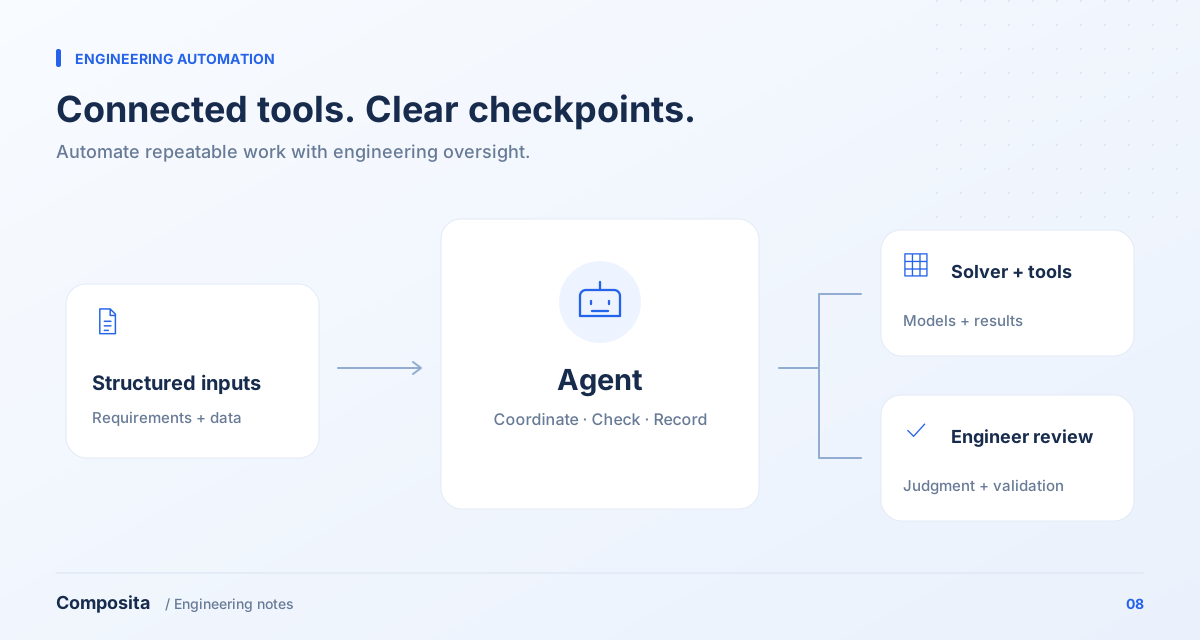
Distinguish the agent from the solver
An agent can coordinate tools, organize requirements and track progress. Numerical analysis still needs suitable models, material data and solution methods. Generated text or parameters are not automatically validated engineering results.
An established analysis workflow can be divided into testable tool operations: reading material and layup data, executing defined load cases and collecting ply-level results. Specify inputs, outputs and error handling for each operation. Connecting the tools does not, by itself, validate the model.
Keep engineering checkpoints visible
Before solving, make loads, supports, material sources, layup and objectives available for review. Missing inputs, tool failures or implausible outputs should be identified clearly and stop downstream steps that depend on them, rather than being hidden by a polished report.
Record tool executions, file revisions, parameter changes and review decisions. Ensure that comparisons share the same assumptions. Reproducibility and inspectability are important automation benefits, beyond a faster progress indicator.
The direction of Composita OS
Composita OS is an agent platform under development within Composita. Its goal is to connect CAD preparation, composite modeling, simulation, failure assessment and delivery so engineers can focus more time on requirements and design decisions.
This article describes automation methods and product direction, not confirmation that every listed capability is available today. Evaluate adoption through demonstrable integrations, reproducible examples and a defined validation scope. Accuracy and applicability must be established for each task.
References & further reading
Bring your engineering question.
Discuss material selection, structural design and analysis for your component with Composita.