Separate covers, mounts and moving structures
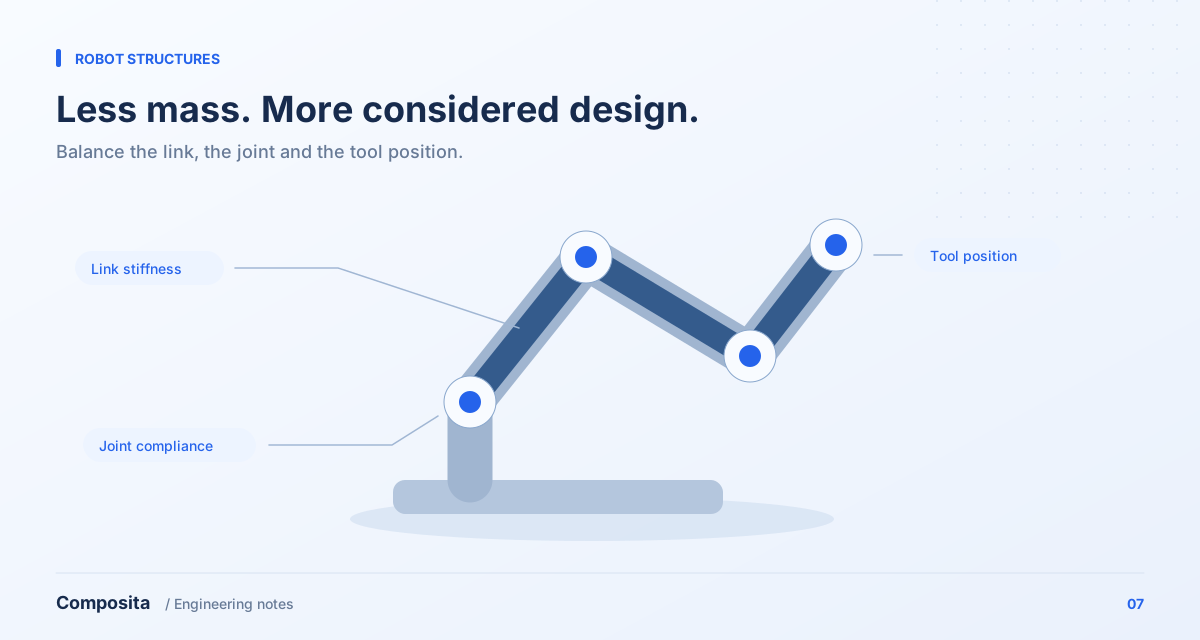
Robot components perform different jobs. A cover may prioritize protection and assembly, a sensor mount may be limited by relative displacement, and a moving link needs an assessment of inertia, stiffness and interfaces. Lower material density alone does not justify replacing every part.
List components with their purpose, mass, center of gravity, loads and acceptance metrics. Select candidates with a plausible effect on system performance so development effort goes where it can answer a meaningful question.
Assess mass distribution and deformation together
Moving structures call for consideration of mass distribution and rotational inertia. Removing equal masses at different locations can have different effects, which must be evaluated against the actual mechanism and control requirements.
Check tool or sensor displacement, rotation and dynamic response as weight is reduced. Added interface compliance can undermine an expected positioning or vibration benefit. Component mass should not be the only success metric.
Interfaces and environment can decide feasibility
Review bearing seats, threads, cable supports and service access. Precision fits or repeated fastening may favor metal interfaces with a composite primary structure, but load transfer and tolerance accumulation still need assessment.
Include operating temperature, cleaning, collision exposure, dust and electrical requirements. Select the material and process for actual conditions; appearance or fiber type alone does not establish a finished component’s thermal or protective performance.
Validate one component before scaling up
Choose a candidate with defined geometry and interfaces, establish a baseline and compare a composite concept under the same conditions. A prototype review can cover dimensions, mass, static displacement and necessary dynamic measurements, with assembly conditions recorded.
If the evidence supports adoption, assess supply, production consistency, inspection and maintenance. A Composita discussion can begin with material selection, structural design and analysis scope tied to verifiable requirements.
References & further reading
Bring your engineering question.
Discuss material selection, structural design and analysis for your component with Composita.