Start with the job the component must do
Define the envelope, loads, allowable deformation, operating temperature, production volume and disassembly frequency before comparing materials. Density alone does not tell you which finished component will be lighter at the same functional performance.
An equipment bracket carries the payload, acceleration loads and reactions at its supports. A displacement-limited bracket needs a comparison of assembled stiffness, while a space-limited part needs an assessment of available section depth and thickness. These can lead to different material choices.
Compare complete structures
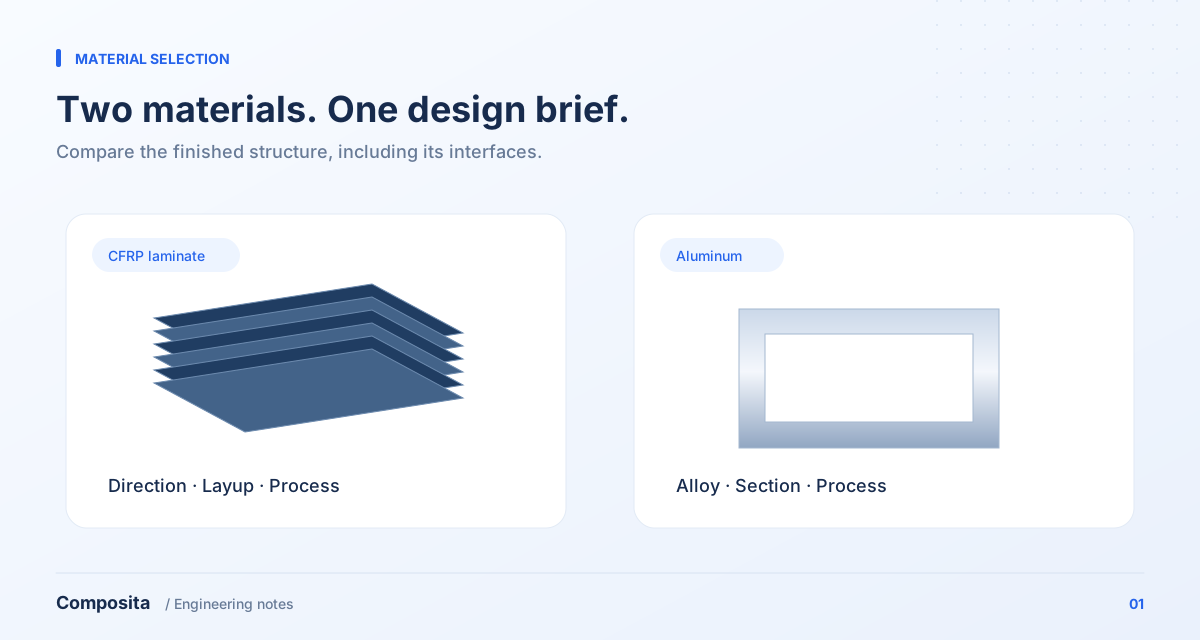
Continuous-fiber composite properties depend on direction. Specify the fiber, resin, ply thickness and laminate instead of treating the strength of a fiber as the strength of a finished component. An aluminum design also needs a defined alloy, temper and manufacturing condition.
Include ribs, inserts, bolts and bonded regions in the mass comparison. Joints can introduce weight and local weaknesses; consider them while developing the structure, not after selecting the material.
Include manufacturing and maintenance
For composites, establish material availability, forming method, tooling, access for layup, machining boundaries and inspection. For aluminum, review machining access, thin-wall production and surface treatment. Request quotations against the same volumes and acceptance conditions.
If mounting holes change frequently during development, first validate the layout with a readily modified structure. A hybrid design with composite panels and metal interfaces may be useful, but still requires interface loads, environmental compatibility and assembly tolerances to be assessed.
Decide through a bounded comparison
Develop two concepts against the same requirements. Compare mass, deformation, failure modes, manufacturing risks and cost, then test the largest uncertainties. A weight-saving percentage from one project is not a prediction for another.
- Document common loads and acceptance conditions.
- Account separately for panels and joining hardware.
- Identify material data sources and their limitations.
- Confirm that a supplier can manufacture the proposed geometry.
- Measure the quantities that determine functional performance.
References & further reading
Bring your engineering question.
Discuss material selection, structural design and analysis for your component with Composita.