Zero degrees needs a reference
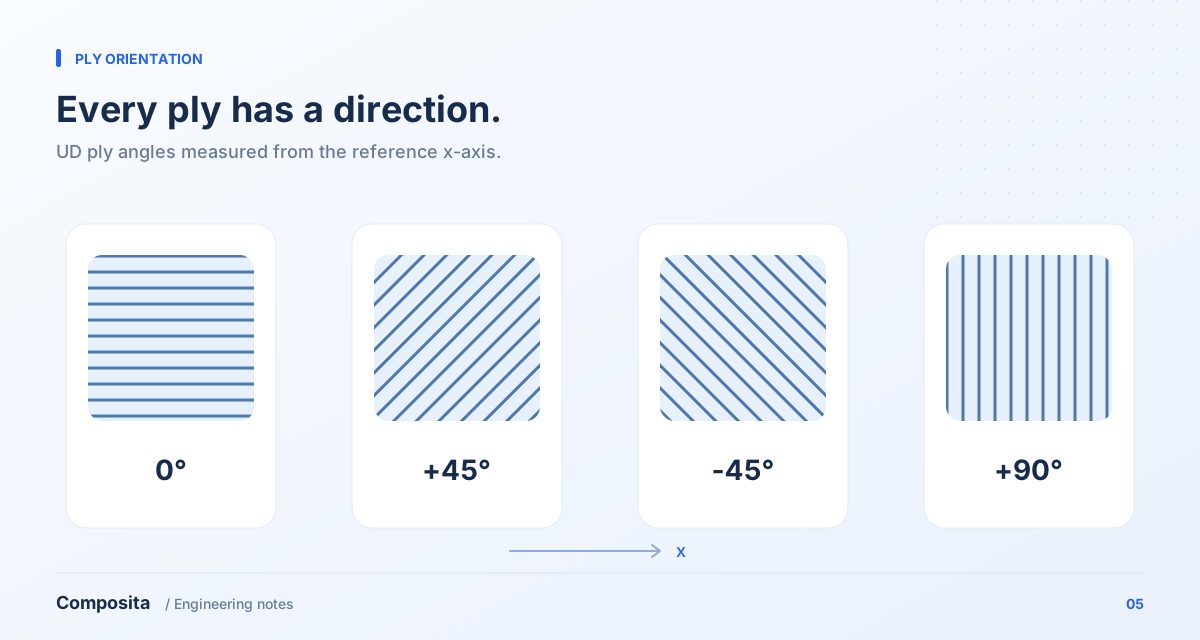
Ply angles are defined relative to a local reference direction. Zero may follow an arm axis, while a curved part can require a spatially varying direction field. Drawings, manufacturing instructions and the analysis model must share the same convention.
A lamina or ply is one layer of a laminate; CFRP means carbon-fiber-reinforced polymer. Unidirectional (UD) material and woven fabric are not interchangeable descriptions. A fabric ply may contain two principal fiber directions. Establish the material form, property definitions and cutting convention before discussing angles.
Use angles to tailor directional behavior
For a unidirectional ply, fibers aligned with a principal load can contribute to carrying that load. ±45° plies are often used to tailor in-plane shear and torsion-related behavior, while 90° plies provide a transverse orientation. Actual proportions depend on the loads and complete structure.
Do not treat simple angle-to-function slogans as a complete design method. Bending behavior also depends on distance from the laminate midplane. Joints, holes, curvature and local loading can change what the layup needs to achieve.
The same proportions can behave differently
Stacking order affects bending and coupling. Under linear-elastic classical laminate theory, a material-and-thickness distribution mirrored about the midplane gives B = 0, eliminating extension–bending coupling. Matched +θ and −θ plies of the same material and thickness give A16 = A26 = 0. Such balance does not generally imply D16 = D26 = 0, so it does not remove every bending–twisting coupling.
Review ply drops, patches and transitions separately. Laminates of equal thickness can respond differently when angle order and coverage change. Manufacturing misalignment, thickness variation and geometric access also belong in the assessment.
Start with a few manufacturable candidates
Hold material, geometry and loads constant while comparing a small set of feasible laminates. Examine mass, displacement, controlling plies and failure modes. Avoid searching a large material-and-angle space before confirming the inputs.
- Mark the reference direction on drawings and models.
- Check every ply material, thickness, angle and position.
- Review symmetry and balance.
- Confirm layup, transitions and ply-drop feasibility with manufacturing.
- Plan coupon or component measurements around the design objective.
References & further reading
Bring your engineering question.
Discuss material selection, structural design and analysis for your component with Composita.